
The Robert Todd Lincoln Collection of Abraham Lincoln Papers: The Long and Winding Road to the Library of Congress
The Robert Todd Lincoln Collection of Abraham Lincoln Papers: The Long and Winding Road to the Library of Congress
by Michelle A. Krowl
The history of the Robert Todd Lincoln Collection of Abraham Lincoln Papers at the Library of Congress is characterized by both physical movement of the collection and long periods of inertia about its ultimate fate, each of which reminds us how truly remarkable it is that the collection survived and made its way to the Library of Congress.
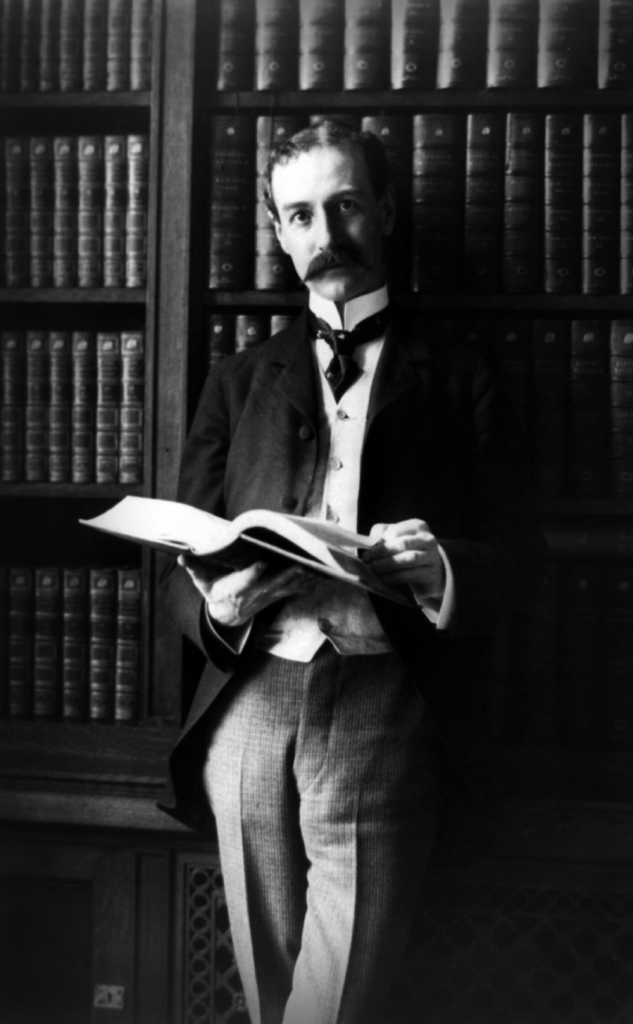
At the president’s death on April 15, 1865, Abraham Lincoln’s eldest son, Robert T. Lincoln, then only twenty-one years old, unexpectedly became the bearer of many familial responsibilities, including being the custodian of his father’s personal papers. Off and on for the next fifty-four years, the burden of Abraham Lincoln’s papers caused anxiety for Robert Lincoln as he endeavored to safeguard the papers and his father’s legacy, fended off incessant requests for access to the documents, and procrastinated in determining the destiny of the collection.
Soon after Abraham Lincoln’s death, Robert reached out to his father’s friend Judge David Davis for help with all aspects of Abraham Lincoln’s estate. Concerned about unnamed malign influences in Washington trying “to get hold of them,” Davis counseled that the president’s papers should be removed from the capital, to which Robert consented. Lincoln’s trusted presidential secretaries, John G. Nicolay and John Hay, who knew the collection better than anyone, packed up the former president’s personal papers at the White House. Robert likely assisted in this task, but his direct participation is difficult to determine, especially as his attention would have been diverted by numerous other details while preparing his mother and brother Tad to leave the Executive Mansion and move back to Illinois.
Whether or not Robert literally had a hand in the packing, by the end of April 1865, Abraham Lincoln’s personal papers at the White House had been collected, packed, and shipped to Bloomington, Illinois, where they were stored in the vault of the National Bank of Bloomington. There they would be under the watchful eye of David Davis, whom Robert trusted implicitly. This represented the first of several occasions in which Robert was able to cede the physical responsibility for his father’s papers to the men he most trusted with Lincoln’s legacy.
Almost immediately, however, Robert began to fend off requests for access to his late father’s papers in support of planned biographies and other projects. Perhaps the first he received came from Prof. Francis James Child of Harvard College, who tried to intervene on behalf of scholar Charles Eliot Norton. Robert replied on April 27, 1865, denying Norton access to the papers. “It will be impossible, however, for the complete work which Mr. Norton contemplates to be written for a number of years,” Robert explained. “Exactly how long it is impossible to say because there are no doubt many documents (I myself know of several) which are necessary to the history but which would be damaging to men now living.” Robert noted that he hoped to have the opportunity to go through the collection “within the next three or four years” in the company of Hay or Nicolay and one or two of Lincoln’s trusted friends to “glean out what is useless and to classify the remainder in some sort.” But Robert remained resolute that “no one will have access to them before that time.”
Robert’s response to Professor Child established a blueprint for his standard response to each inquiry about his father’s papers for decades to come. Time and again he expressed concern that his father’s contemporaries would be represented in the papers in ways that would embarrass them, or their descendants, were the contents to become public during their lifetimes. He reiterated his hope that he would carve out time to go through the papers himself, or in the company of trusted associates, to get a better sense of their content. He anticipated weeding out extraneous materials and imposing some order on the documents. And he would not grant access to the collection until those conditions had been met. Unfortunately, for the vast number of Lincoln biographers, those conditions would not be met during Robert’s lifetime, and Abraham Lincoln’s papers would remain inaccessible to almost everyone.
Robert’s position regarding his father’s papers no doubt reflected at least several concerns. Robert’s biographer, Jason Emerson, described Robert as the “defender of his father’s ever-growing reputation,” and thus providing access to the papers risked relinquishing control of the narrative. Robert also maintained a Victorian sense of privacy, and he worried that the contents of the papers might damage reputations or embarrass the family members of people with whom he interacted, which in turn could have been wounding to him personally or professionally. Of course, there was also the practical consideration that if he provided access to one biographer, it would be harder to deny the next one, which no doubt would have both increased the volume of requests exponentially and the logistical difficulty of making the papers available in a secure environment. Plus, as long as the papers were securely stored in the bank vault in Bloomington, he did not have physical control of the documents, which also proved a handy dodge. Thus, he remained largely in the dark about what the papers actually contained. For these reasons and more, Robert found it preferable to say no. Except to his friends John G. Nicolay and John Hay. Lincoln’s two secretaries had long planned to write a biography of their beloved “Tycoon,” which necessitated access to the papers they had packed up years before. Unlike other prospective biographers, Robert trusted Nicolay and Hay to not only represent his father in a positive light, but to also use Lincoln’s papers with sensitivity.
By 1873, Nicolay and Hay had both returned to the United States from their postwar diplomatic postings in Europe and were getting more serious about undertaking the biography. Nicolay wrote to Robert in May 1873 “to ask you whether you have yet had your fathers papers taken from Bloomington to Chicago, and whether you have done anything toward their examination and arrangement, as you told me you thought of doing when I last saw you in Washington.” The deaths of Lincoln’s Secretary of State William H. Seward in October 1872 and Treasury Secretary Salmon P. Chase on May 7, 1873, signaled to Nicolay the urgency to get started, as reinterpretations of the Lincoln administration had already begun. They would first need time to assess President Lincoln’s papers before acquiring other source materials. “We must of necessity begin with your fathers papers,” Nicolay explained to Robert, “because everything else must be grouped and accumulated around them.”
Perhaps prompted by Hay and Nicolay’s pleas, Robert finally sent for his father’s papers, which were shipped to him in Chicago from the bank vault in Bloomington. But he continued to find more reasons to delay undertaking a survey of them before releasing them to Hay and Nicolay. Nicolay wrote Robert again in March 1874, nudging his friend to release the papers to the secretaries so that they could get to work. “You remember that when I was in Chicago last summer you showed me a small open box of papers in your garret which you told me you had already looked through,” Nicolay reminded Robert. “Why can you not nail up that box and forward it to me by express, and let me utilize the intervening two months between this and the adjournment of our Court in putting them into shape here?” Nicolay had been appointed as the marshal of the Supreme Court of the United States in December 1872, which had the advantage of giving him blocks of free time to work on the papers and access to a vault in the basement of the U.S. Capitol that would be secure from prying eyes. Appealing to Robert’s memory of the recent conflagration that destroyed portions of Chicago in 1871, Nicolay added that his storage room in the Capitol was “more secure than any safe in Chicago against fire.”
Robert finally relented and agreed to send his father’s papers to Nicolay in Washington. By July 1874, the Lincoln papers had been delivered to John Nicolay at the Capitol. By entrusting the papers to Nicolay, Robert also relieved himself of responsibility for the collection. As long as Nicolay maintained physical custody of the Lincoln papers, Robert knew they were in good hands, that Nicolay would guard access to them, and that to some degree they were now Nicolay’s problem. As Lincoln scholar David C. Mearns of the Library of Congress later wrote, “then Mr. Nicolay undertook the gigantic task of putting them in order, sorting them, classifying them, establishing dates, relating them to other documents in his keeping, and, for him most important of all, devising, on the basis of their contents, plans for a comprehensive treatment of the Lincoln period.”
With Nicolay’s yeoman labor organizing the papers, and with research assembled by both authors, Hay and Nicolay were now ready to get down to the writing. Serialized articles first appeared in The Century magazine beginning in November 1886 and continued to February 1890. This was followed in 1890 by the publication of the full ten-volume biography, Abraham Lincoln: A History. In April 1894, Hay and Nicolay published a two-volume edited edition of Lincoln’s writings, titled Complete Works of Abraham Lincoln. Nicolay also used the Lincoln papers to research and write his own articles about Abraham Lincoln, including those on the Gettysburg Address and Lincoln’s personal appearance.
With their Lincoln publications, Hay and Nicolay relieved Robert of a few burdens with regard to his father’s papers. They offered Robert the option to read and edit drafts of the manuscript before publication, and generally deferred to his preferences. This confirmed Robert’s trust in the secretaries to use his father’s papers in line with his comfort level as to the information shared with the public. And because both Abraham Lincoln: A History and Complete Works utilized the Lincoln papers Robert had loaned Nicolay, he could instead refer people who requested access to his father’s papers to those publicly available sources.
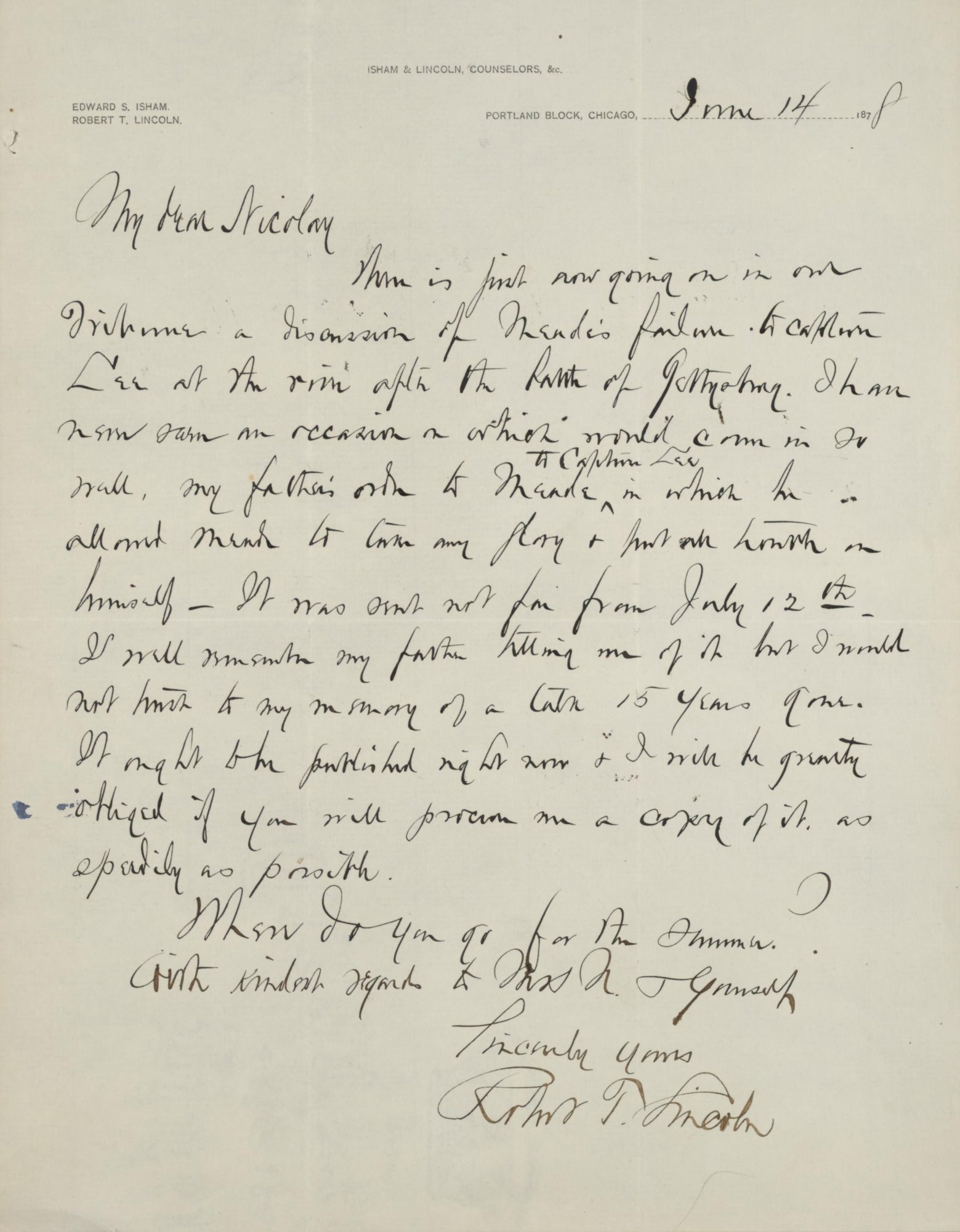
According to Nicolay’s daughter Helen, her father’s possession of the Lincoln papers may have saved Robert from an impulse to jump into the fray when he read inaccuracies that could have been disproven by documents in the collection. In June 1878, Robert requested that Nicolay find a document in the papers with which to respond to a newspaper debate about George G. Meade and Robert E. Lee at Gettysburg. Nicolay responded that as he was out-of-town, he could not retrieve the requested document. But, Nicolay went on, “even if I were yet in Washington I would first most earnestly ask you to recall the request. There is to be no end to these newspaper discussions and you cannot possibly correct them all. Where you do, the central document or fact is rudely torn from its necessary connections and misdated and misquoted, and by the third day flippantly condensed into three lines by the ‘items’ man. Since I have been collecting and arranging,” Nicolay concluded, “I have been amazed to find how these things sink out of sight and become fossilized in newspapers.” While Nicolay was no doubt accurate in his assessment of the ephemeral nature of newspaper wars and in counseling Robert to steer well clear of them, he was also likely exerting territorialism over the papers, giving him and Hay the exclusive “scoop” on the contents for their projects.
As for those papers themselves, they traveled a bit around Washington while in Nicolay’s custody. While marshal of the Supreme Court, he had access to secure storage in the Capitol. But even before he resigned this position in December 1887 and presumably relinquished control over the Capitol space, he must have taken some documents home while working on the biography. When the Lincoln papers first came into Nicolay’s custody, he lived at 230 First Street SE, but by 1876, Washington, D.C., city directories record him as living in the 100 block of B Street SE. By 1880, he had moved about a block away to 212 B Street, where he lived for the next twenty-one years.
When Nicolay died on September 26, 1901, his daughter Helen and Robert Lincoln were faced with the problem of what to do with the Lincoln papers. Fortunately, their good friend John Hay was then the secretary of state, and everyone agreed that the papers should be transferred from Nicolay’s home on Capitol Hill across town to the vaults of the State Department, which was then located in what is now the Eisenhower Executive Office Building next to the White House. But that solution proved to be a temporary one. Hay died in July 1905, which necessitated that Robert once again assume both physical and intellectual control over his father’s papers.
In October 1905, Robert came to Washington to take possession of the papers, just over forty years after they had first become his responsibility in practically the exact same location. The seven steamer trunks were shipped to Chicago, where they would be stored in the safe in Robert’s office for the next several years. Robert assigned his own trusted secretary, Charles Sweet, to “examine, organize, and ‘overhaul’” the collection. Now that both Nicolay and Hay were gone, Sweet was the only person who knew the contents of the Lincoln papers. He would update Robert with his findings, and sometimes Robert would then gift documents to the relevant families.
This situation changed yet again around 1911 when Robert and his wife, Mary, moved from Chicago to Washington, D.C. After one year on 17th Street, they moved to 1775 N Street, near Dupont Circle. After Robert’s secretary Charles Sweet died in 1912, Robert stored his father’s papers in his own homes, or perhaps in a secure storage vault somewhere in Washington.
In January 1918, Robert moved again, this time to a mansion at 3014 N Street in Georgetown. But regardless of where he lived in Washington, he transported his father’s papers with him as he moved with the seasons between Washington, D.C., and his summer home Hildene, which he’d built in Manchester, Vermont, in 1905. Although as a Pullman Car Company executive Robert had access to his own railroad car, the well-traveled Lincoln papers could have been easily destroyed in one railroad accident.
But the long-term safety of the collection was on Robert’s mind, even as he shuttled the papers back and forth. Not long after Nicolay’s death, Librarian of Congress Herbert Putnam initiated a conversation with Robert about the disposition of his father’s papers, encouraging Robert to consider the Library as a safe and appropriate repository for the archive. Robert replied in January 1902, admitting that “the subject you speak of is one which is often in my mind.” He further admitted that Nicolay’s long custodianship of the collection had allowed him to defer any decisions. But Nicolay’s death brought the issue to the fore again. “If my son was still alive I should probably leave these papers in his hands,” Robert noted, “but as it is, I think it my duty to select some depository for them, just what it will be I am not yet prepared to say.”
Every so often Putnam gently nudged Robert about the collection, including after Robert again took possession of the papers after John Hay’s death in 1905. But for years Robert politely sent similar replies in which he cited ill health or other commitments as keeping him from examining the papers himself, which he claimed he wanted to do before making any decisions. “It is a subject which is constantly present in my mind,” he reiterated in 1906, “and I do not intend to let it drag along much longer.” For all Robert’s worry about the papers, however, he continued to let the issue drag on year after year, deferring any final decisions while at the same time jealously guarding the collection.
The dam finally broke in 1919, when Robert deposited his father’s papers at the Library of Congress. In addition to the years of gentle persuasion by Putnam, the timing may have been influenced by two related events. The planning of the Lincoln Memorial, with a projected completion date in 1919, may have prompted Robert to think even more seriously about his father’s legacy. Perhaps more importantly, though, during the memorial process, Robert had been in close contact with Charles Moore, who had headed the Fine Arts Commission in Washington, D.C. In early 1919, Herbert Putnam appointed Moore as the new chief of the Library’s Manuscript Division, which meant that Robert’s new friend would have jurisdiction over the Lincoln papers should Robert decide to donate them. And as Moore noted in a March 5, 1919, letter to Robert, the Library had recently acquired the papers of former presidents Theodore Roosevelt and William H. Taft, the latter of whom Robert knew personally and who had led the Lincoln Memorial Commission. Regardless of the reason, it was a turning point in the history of the Lincoln Papers when Charles Moore was able to pen a simple note to the chief of the Library’s Mail Division on May 6, 1919: “Please have the wagon call at Mr. Robert T. Lincoln’s house, 3014 N Street, N.W., for seven trunks of papers to be delivered unopened to the Manuscript Division.”
Robert Lincoln’s collection of Abraham Lincoln’s papers duly arrived at the Manuscript Division in May 1919. But the deposit came with important restrictions, as noted in a May 7 memorandum by acting Librarian Appleton Griffin: “The papers of Abraham Lincoln belonging to the Hon. Robert T. Lincoln have been deposited in the Library under the following conditions: 1. The fact that the Papers are in the Library is to be kept from the public. 2. One of the officials of the Library is to examine and arrange them under the direction of Mr. Lincoln[.] 3. The Papers are to be consulted only after permission has been granted by Mr. Lincoln.” Robert still exerted control over the collection after he entrusted the physical safety of the papers to the Library of Congress.
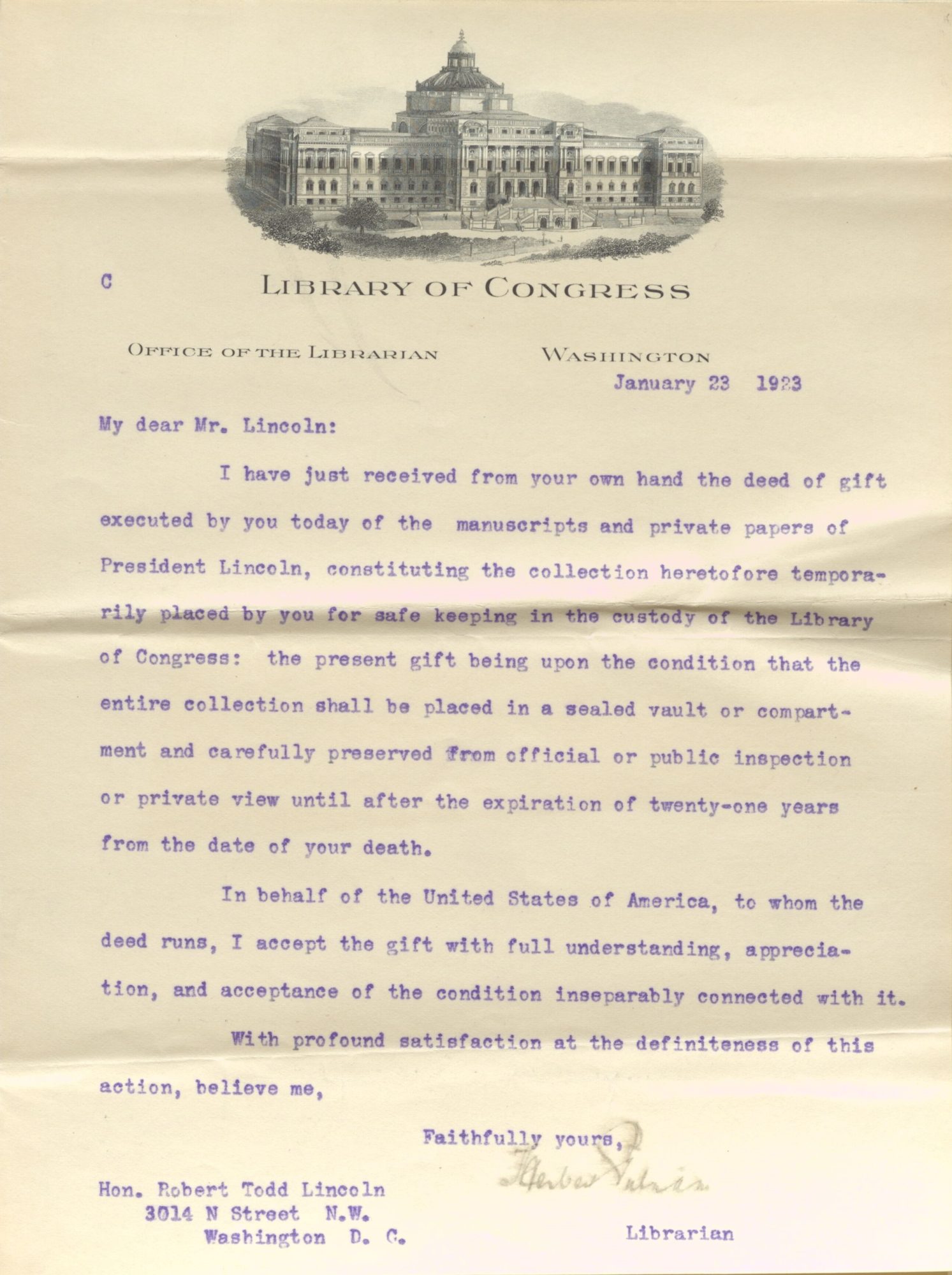
This remained true even when Robert officially gifted the Lincoln Papers to the Library in 1923. According to the deed of gift, “all of said letters, manuscripts, documents and other papers shall be placed in a sealed vault or compartment and carefully preserved from official or public inspection or private view until after the expiration of twenty-one (21) years from the date of my death. This condition is imposed by me because said papers contain many references of a private nature to the immediate ancestors of persons now living, which, in my judgment, should not be made public, and also much information and matter of a historical character which I have heretofore authorized and permitted JOHN G. NICOLAY and JOHN HAY to use in the preparation of their Life of my father.” Robert modified the terms of his gift in 1926 to authorize the Librarian of Congress to have an index to the collection made, and to permit his wife, Mary Harlan Lincoln, to examine the Lincoln Papers or grant others permission to do so.
When Robert died on July 26, 1926, the twenty-one-year countdown clock to the opening of the Abraham Lincoln Papers began. Appeals to his widow commenced, which she routinely denied. Mary Harlan Lincoln referenced her husband’s position regarding the papers and decided to follow his example by erring on the side of caution. In the meantime, she, and then her daughter Mary Lincoln Isham, continued to donate additional items to the Library of Congress, including the contents of Lincoln’s pockets on the night of April 14, 1865, the Bible he used at his first inauguration, and Mary Lincoln’s pearls.
For most of the years between 1926 and 1947, what would become known as the Robert Todd Lincoln Collection of Abraham Lincoln Papers remained sealed away in vaults at the Library of Congress. In line with Robert’s restrictions, a Library staff member made a preliminary start on cataloging the materials but was unable to make much progress and the effort was abandoned. In the meantime, the Manuscript Division moved from the Main Building (now known as the Thomas Jefferson Building) across Second Street to the new Library of Congress Annex, now known as the John Adams Building, which opened in 1939. By coincidence, since Nicolay’s 212 B Street house had been demolished to make way for the Annex, in a way the Lincoln Papers were coming home.
During World War II, the Lincoln Papers endured one other unexpected move. Given the vulnerability of Washington, D.C., to attack, the collections of the Manuscript Division were evacuated for safety during the war. Most of the Lincoln Papers, including the Robert Todd Lincoln Collection, were moved to Alderman Library at the University of Virginia in Charlottesville. A few higher profile items, such as Lincoln’s handwritten Gettysburg Addresses and the second inaugural, were moved to Fort Knox in Kentucky. Fortunately, the capital remained safe, as did the evacuated collections, which were able to return to Washington in September 1944, once the crisis had passed.
But another event was looming on the horizon: the projected opening of the Robert Todd Lincoln Collection at the stroke of midnight on the morning of July 26, 1947, the expiration of Robert’s twenty-one-year restriction.
The first order of business was to finish processing the collection for research use. In the run-up to July 1947, C. Percy Powell and Helen Bullock bore the primary responsibility for arranging, cataloging, and indexing the collection. Powell had previously worked on the Library’s Herndon-Weik Collection of Lincolniana, and was thus familiar with the subject matter and the requirements of the Lincoln Papers. Powell and Bullock prepared index cards for each item in the Lincoln Papers. The papers were organized, prepared for binding, and sent to the bindery in accordance with the preservation protocols then in favor. The roughly 18,000 documents in the Robert Todd Lincoln Collection were bound in 194 volumes covered in blue buckram, with red leather labels, and gold identification lettering, which they still retain today.
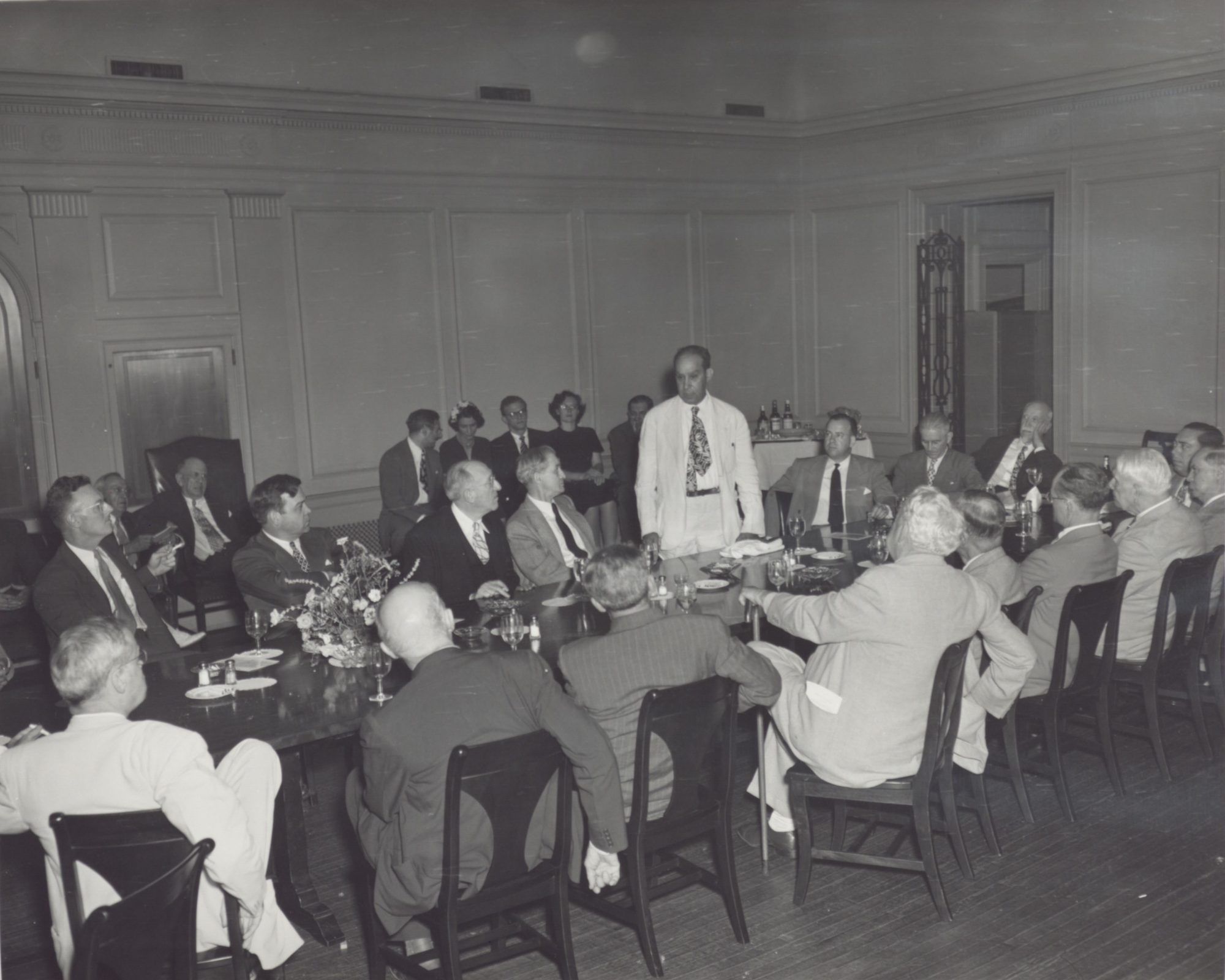
Then there was the celebration itself. On Friday, July 25, a group of notables in the Lincoln world were invited to a pre-unveiling dinner in the Whittall Pavilion hosted by Librarian of Congress Luther H. Evans. Attendees included Carl Sandburg, Roy P. Basler, Alfred Whital Stern, James G. Randall, F. Lauriston Bullard, and John E. Washington.
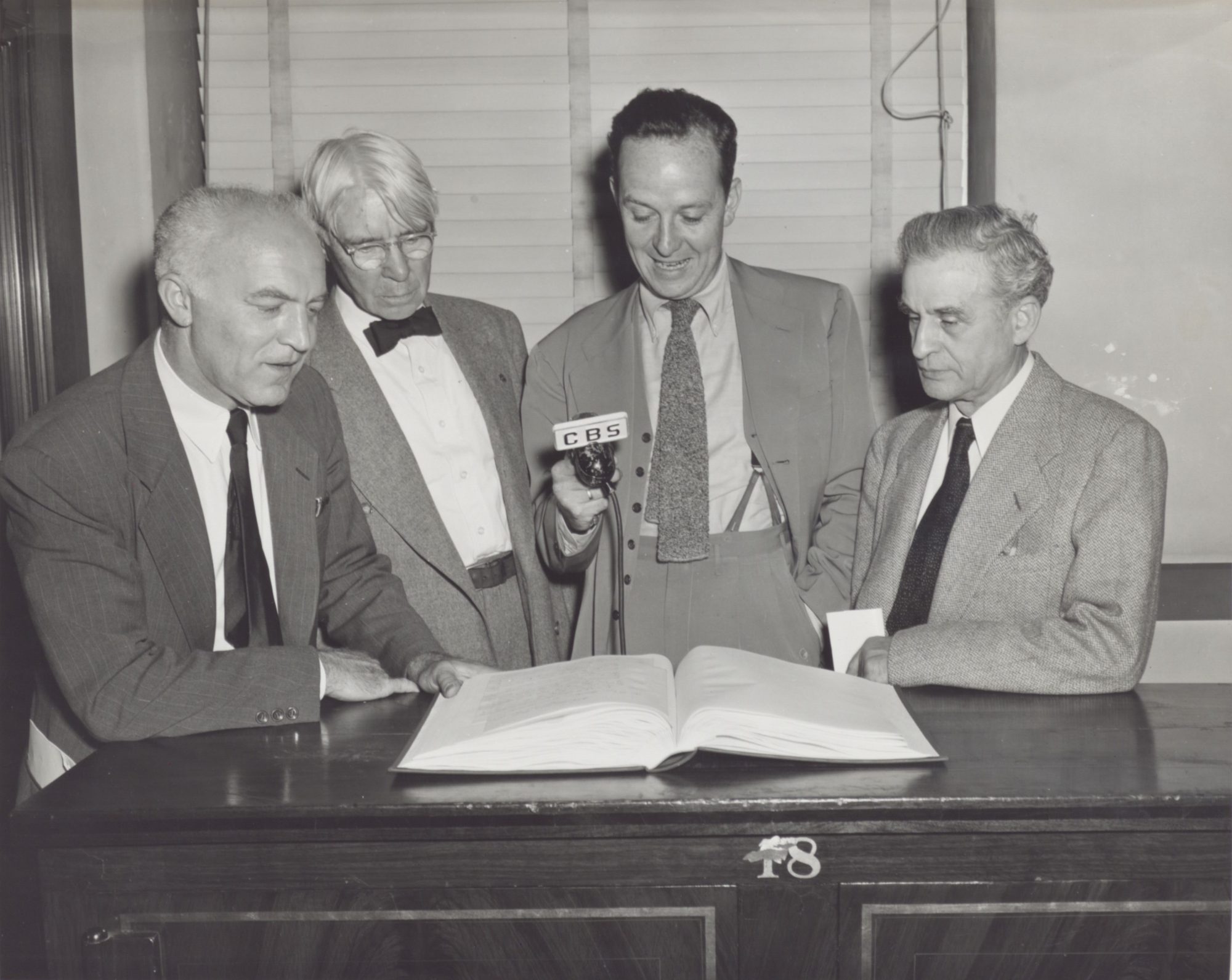
As the dinner progressed, the attendees speculated on what might be included in the collection, or what they hoped to learn more about. Randall hoped “to find a fuller picture of Lincoln at work” through his speeches, messages, and letters. Bullard hoped, among other things, to know if Lincoln wrote the Bixby letter. Washington “spoke movingly of Lincoln’s relations with Negroes and of his own hopes that there would be more facts on that subject in the Papers.” Then, at the conclusion of the dinner, Colton Storm of the University of Michigan reported that “like thirty-one schoolboys unexpectedly released from school in spring, we scampered from the room and through the empty halls of the Library to the Annex. There the Papers waited.”
In view of invited media outlets, at midnight the Librarian read Robert Todd Lincoln’s 1923 deed of gift and pronounced the collection to be open. Under Evans’s supervision, C. Percy Powell started opening the combination locks on the vaults holding the Lincoln Papers. Once the vault doors swung open and the Lincoln Papers became available, reporters asked Library officials and Lincoln celebrities for their initial reactions to what they saw. Some expressed their excitement over individual documents and what they might learn from seeing the originals. Paul Angle of the Chicago Historical Society pointed to the human-interest stories, which he explained “fascinate me no less than its scholarly potentialities. There are just literally hundreds of letters here written by plain people that are forgotten by history long ago.” James Randall’s initial takeaway of the breadth and content of the papers was that “in short, they reveal this remarkable man’s behavior in a cruelly exacting job.”
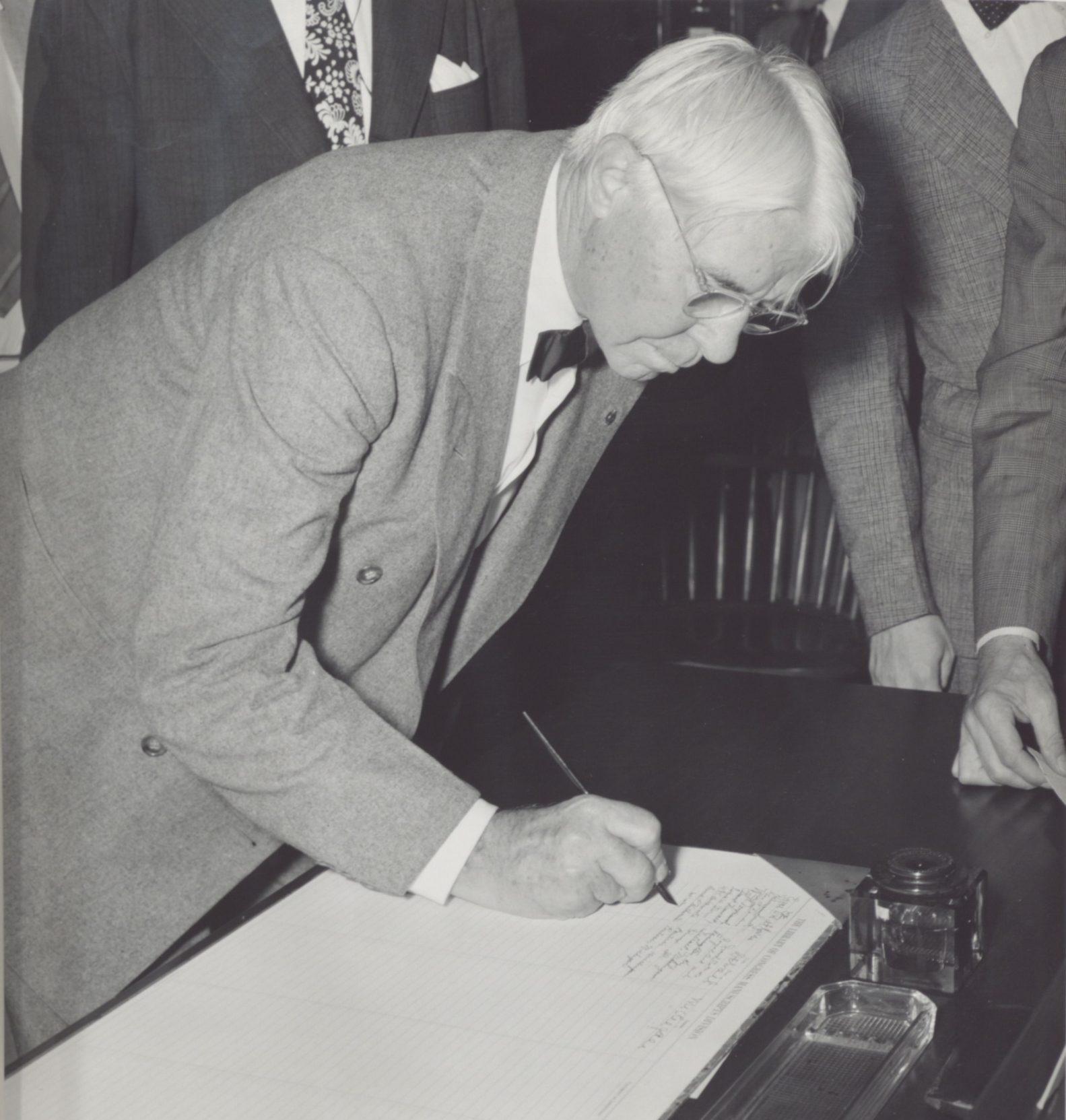
After the preliminaries concluded about 1 a.m., the volumes were transported to the Main Building. The Lincoln scholars returned to the Whittall Pavilion, where they had a few precious hours to pour over the Lincoln Papers for themselves. As Randall noted in his diary, “for hours these men were as busy as bees, going to the index, then to the papers, back to the index, taking notes, going into huddles to exchange first impressions.” When the scholars concluded, the Library staff went into action in the early morning hours preparing additional press releases for the media scrum around noon.
At 4:00 p.m. on Saturday, July 26, 1947, the public was invited to the opening of the Lincoln Papers. The festivities began in the Great Hall of the Library with speeches from the Librarian of Congress, Illinois Senator C. Wayland Brooks, who also chaired the Joint Committee on the Library, and a keynote address from Roy P. Basler, who is now best known as the general editor of the Collected Works of Abraham Lincoln. Among the invited guests at the public event were Lincoln descendant Robert Todd Lincoln Beckwith and Dorothy Lamon Teillard, the elderly daughter of Abraham Lincoln’s friend Ward Hill Lamon. She may have been the only attendee who had actually met Abraham Lincoln.
In the days and weeks that followed, the Lincoln Papers received a fair amount of attention in print and radio media. Thematic press releases from the Library of Congress generated new stories, while Lincoln scholars and Library staff were called upon to comment on the Lincoln Papers in media outlets. And with the collection open to the public, they were now able to visit the Manuscript Division reading room to explore for themselves.
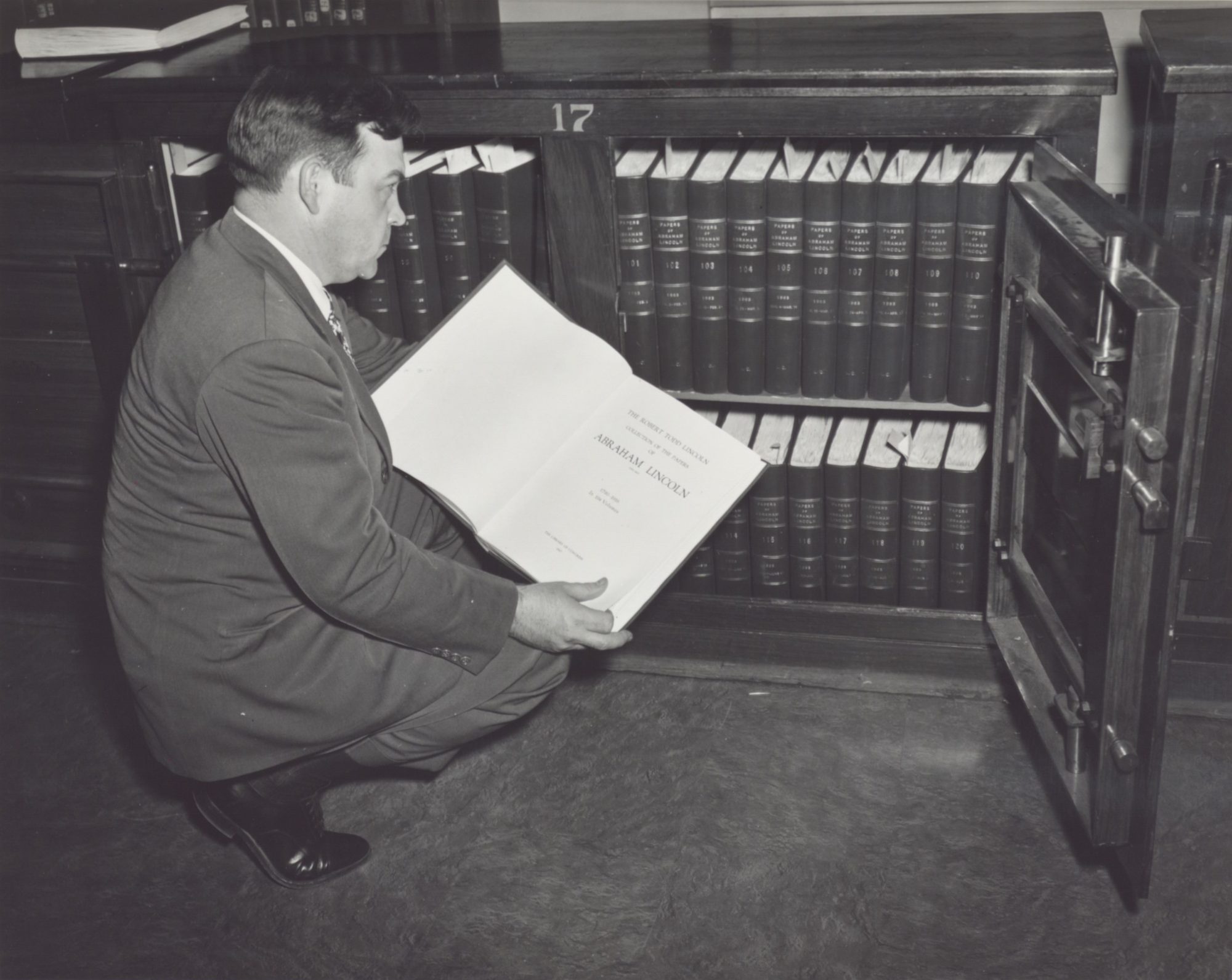
And what did scholars and the public find? Well, no real bombshells, much to the chagrin of the conspiracy-minded public who wanted answers to long-circulated rumors about Lincoln’s assassination. In fact, prior to the opening of the collection, Library staff and Lincoln scholars had been downplaying the chances of finding salacious material in favor of emphasizing the long-term research potential of the content. Since Hay and Nicolay had already brought to light many of the Lincoln documents in the collection, and since the bulk of the material consists of letters written to Lincoln, the real treasures to mine in the Lincoln Papers are the day-to-day operations of the Lincoln White House, the varied issues the public brought to his attention, and the overwhelming responsibility it was to be Abraham Lincoln while running both a nation and a war.
“Despite the dearth of scandal and surprise, it is the consensus of the Lincoln scholars and collectors who attended the ceremonies on July 26 that this is in fact the richest single collection of Lincoln material extant,” Helen Bullock wrote later in the year. David Mearns hit the nail on the head when he predicted that the opening of the Robert Todd Lincoln Collection would “not mean sudden, blinding discovery but the opportunity for discovery. For the next twenty, fifty, perhaps one hundred years, they will be the objects of intense and devoted and searching scrutiny.”
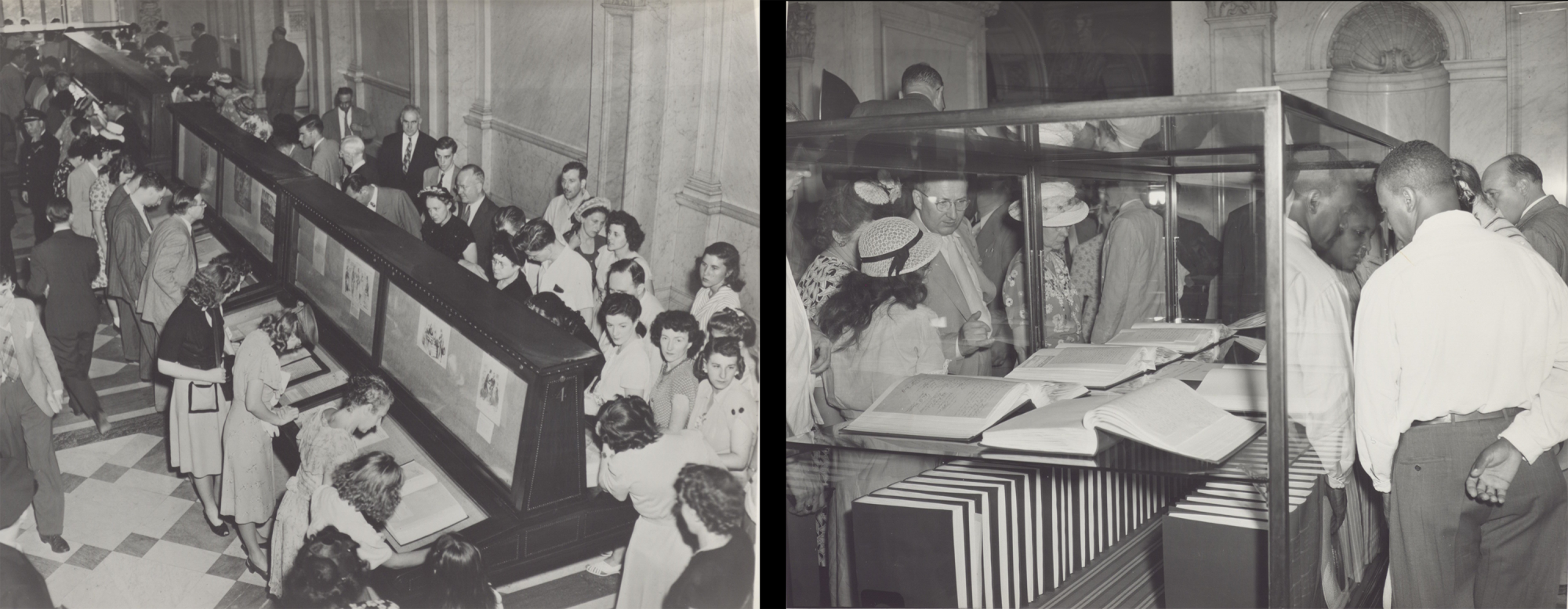
This has proven to be true. Since their opening in 1947, the Robert Todd Lincoln Collection and the other materials that form the Abraham Lincoln Papers at the Library of Congress continue to be searched, scrutinized, and reinterpreted by each generation, often using new technologies to access and analyze the content. Whether accessed in their original format, or by the microfilm edition that stretches two miles long, or through published editorial editions like The Collected Works of Abraham Lincoln, or through the Library’s then-pathbreaking American Memory digital platform of the early 2000s, or since 2017 the enhanced and expanded Abraham Lincoln Papers online presentation, the Abraham Lincoln Papers continue to fuel new opportunities in Lincoln scholarship.
But the Robert Todd Lincoln Collection had one last move to go. When the new James Madison Memorial Building of the Library of Congress opened in May 1980, the Manuscript Division found a new home in a prominent position just off the main entrance. And within the division’s secure and climate-controlled stacks are the 194 volumes of the Robert Todd Lincoln Collection with the other series that make up the Abraham Lincoln Papers. These well-traveled documents have now resided in each of the three Library buildings on Capitol Hill.
But regardless of what building houses the originals, or through which surrogate format the public accesses the content, there are still some fundamental truths about the Lincoln Papers. As David Mearns wrote shortly before the Robert Todd Lincoln Collection opened, “the curtain is going up. In a moment the Papers themselves will become your property. Mr. Lincoln carried them in his hat. You can carry them in your hearts where they belong.”
Michelle A. Krowl is Civil War and Reconstruction Specialist in the Manuscript Division of the Library of Congress.