On Holiday with the Lincolns: The Letters of Robert Lincoln’s College Friend, Richard J. Meconkey
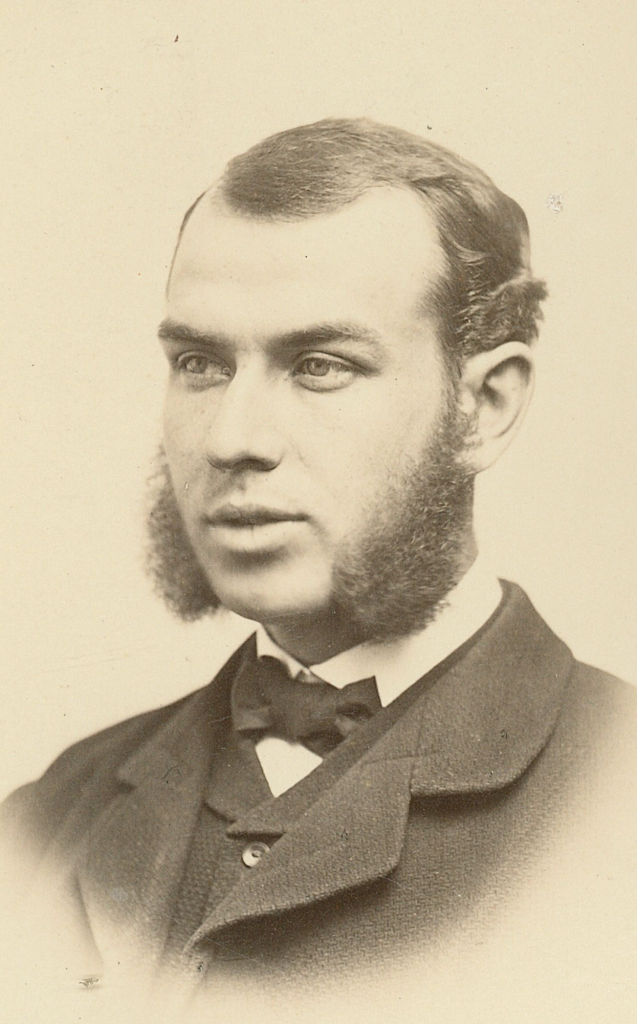
Robert Todd Lincoln first met Richard J. Meconkey (pictured here) at Phillips Exeter Academy in 1859. The two remained friends when they joined the class of 1864 at Harvard. (Harvard University Archives)
On Holiday with the Lincolns: The Letters of Robert Lincoln’s College Friend, Richard J. Meconkey
by Jason Emerson
Abraham Lincoln once wrote, “the better part of one’s life consists of his friends.” His son Robert had many friends, some of whom were lifelong—such as John Hay and John Nicolay—and some who came and went with the circumstances. During his year at Phillips Exeter Academy from 1859 to 1860, Robert made a friend in his classmate Richard J. Meconkey, a young man from West Chester, Pennsylvania, whose father was an eminent banker and solid Republican. The two boys were so close that Meconkey became an intimate of the Lincoln family, joining the “presidential suite” through part of Pennsylvania during the inaugural journey (including his eyewitness account of the night Lincoln was told about the plot to assassinate him in Baltimore), spending summer vacations at the White House in 1861 and 1862, hosting Robert at the Meconkey home in West Chester, and joining in most of Mrs. Lincoln’s much-publicized three-week summer trip in August 1861.
Young Meconkey detailed his experiences with the first family in numerous letters home to his parents, David and Sarah Meconkey, and his friend Jennie Johnson. Their family correspondence, currently housed in the Chester County History Center, in West Chester, Pennsylvania, constitutes an amazing insider look into the Lincoln White House and the first family during the first two years of the Civil War—and is a primary resource never before utilized in Lincoln scholarship other than in my Robert Lincoln biography, Giant in the Shadows.
Transcribed below are ten letters from the Meconkey Family Papers, spanning from February 1861 to July 1862. Due to space limitations, any parts of the letters not specifically about the Lincolns or important historical moments—such as opening and closing lines, and family matters—have been omitted, as signified by ellipses.
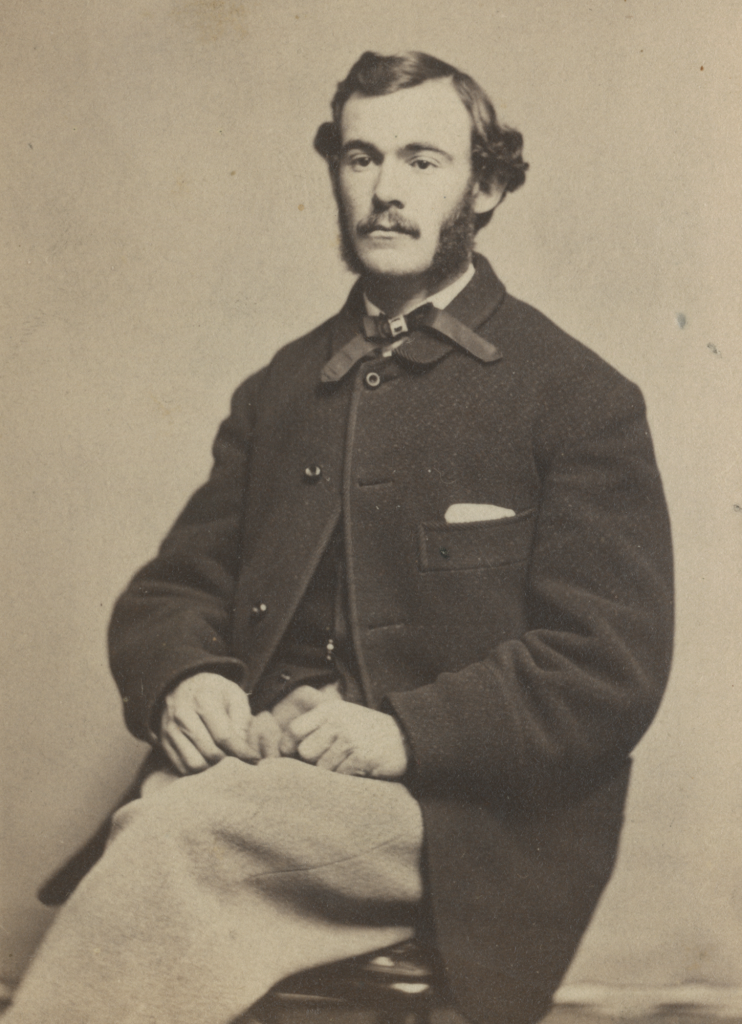
Robert Lincoln’s friend George Latham (LFA-0289)
Richard Meconkey to Sarah Meconkey
Philadelphia, February 24, 1861
Dear Mother,
According to promise, I will endeavor to give you a brief account of my excursion to Harrisburg as a member of the suite of the President-elect. I caught a glimpse of Father as I drove off from the Continental in the carriage assigned to Bob & friends, but did not get a sight of yourself on Arch St. where I believe you told me that you would be. In our carriage was [George] Latham [a Springfield friend of Robert’s], John Hay assistant secretary, Bob & myself. All young fellows, and quite willing & ready to acknowledge the fain glances & bright smiles directed to the vehicle containing the “Prince of Rails.” We took the cars at West Philada, two in number, one for the committee the other exclusively for Mr. Lincoln & party. The car was nicely arranged, having inside two comfortable lounges, and very deep luxurious chairs. We were together like one family, each perfectly familiar with the others, and all distributing themselves over the car as their inclinations directed. The President & wife’s easy manners and good humor throwing no restraint over the party, never requiring them to keep at a distance. Mrs. Lincoln was exceedingly kind and agreeable, treating Latham & myself in the same motherly way that she treated Bob. The old gentleman, sat in his chair, looking somewhat tired and fatigued, seemed to have no direction of his own affairs, but held himself agreeable to the wishes and say of Col. [Elmer] Ellsworth or [Senator Charles] Sumner, who have the direction of his movements.
You wished me to notice Mrs. Lincoln’s dress—She had on a brown traveling dress, nice black cloth cloak, and dark velvet bonnet.
At Harrisburg Mr. Lincoln was taken in a carriage, open barouche, drawn by six white horses, we in two horse carriages, the military were drawn up on both sides of the road, making a grand appearance and salute—firing every half minute. We took dinner at six o’clock, had a nice cold lunch on the cars, and also one waiting at Harrisburg.
The bill of fare was very fine at Dinner.
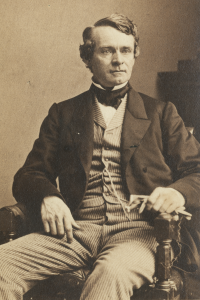
Pennsylvania Governor Andrew G. Curtin (OC-0517)
Mr. Lincoln occupied the head of the table, Gov. [Andrew G.] Curtin on the right and Mrs. Lincoln on the left, and then the suite ranging on down the table. Mr. Curtin was the only person outside of the party. Mrs. L was dressed in a purple silk with rather bright flowers, and a very long trail, lace head-dress with gold flowers. She looked quite well.
While at the table a dispatch came from Mr. [William H.] Seward requesting Mr. Lincoln to come on privately. Several of the gentlemen Mr. L included retired to another room, but came back to finish dinner—some time in the night Mr. Lincoln gave the people the slip, and went on to Washington incog.—the party followed the next morn about nine o’clock, when I bid them goodbye, strolled around the city, up on to the State House etc until half past twelve when I also took my departure. In the West Chester car I met Mr. Chase who had been at West Chester, and who informed me that Father would be at the Jones Hotel this eve & where I shall go to meet him as soon as I’ve had tea. Affectionately
Your Son
Dick
Richard Meconkey to Sarah Meconkey
Washington, D.C., July 25, 1861
Dear Mother,
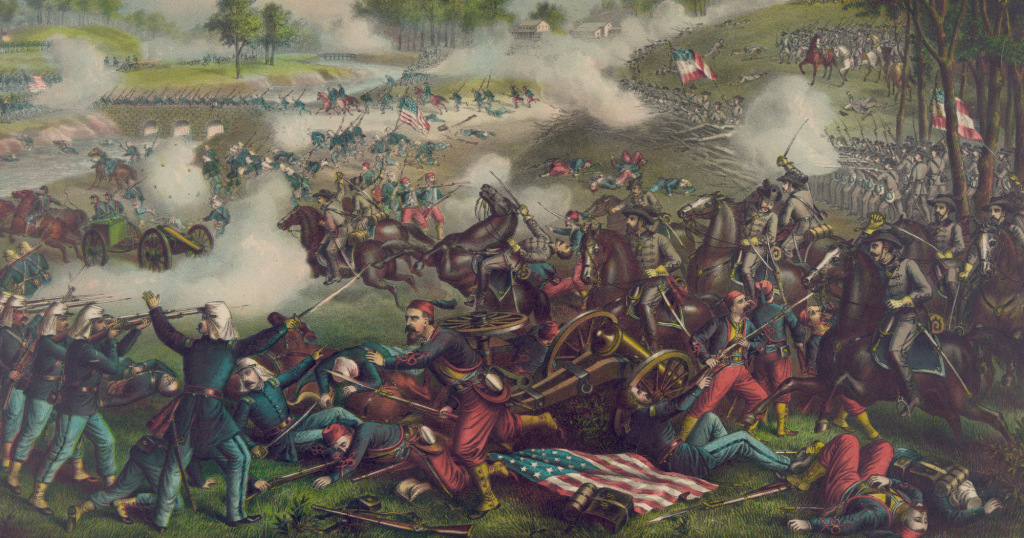
Your letter of apprehension was brought to my room this morning—I mentioned the subject of it to Mrs. Lincoln at the breakfast table—who immediately sent me off to write, to relieve your fears—and to tell you from her, “that she felt safer, and considered Washington more secure [from Confederate invasion after the Union loss at the battle of Bull Run] than the border of Pennsylvania, and couldn’t think of letting me go on so short a visit—”.
There is not the slightest danger Mother, of their ever attacking the city—Mr. Lincoln is even in quite good spirits over the battle of the other day—he told us yesterday that he had learned that not more than 750 of our troops—all told—were lost the other day. That is the true state of affairs, as it comes out after investigation. The Zouaves, who were completely cut to pieces—have 600 of their number in Alexandria, and about 150 strolling around the streets here—which nearly concludes their original number.
Mrs. Lincoln just came in and said that she would write you a note herself, if she had time—to tell you, “that whenever it might become necessary to vacate the place, we will have a car at our command—that she felt safe nowhere but here—”.
I visited the fortifications at Arlington Heights yesterday morning—and they can be held in the face of the whole Southern people by the troops now in possession of them.
The state of the case, is that, in the stampede the other day the enemy did not make the slightest pursuit whatever, and since the battle they have not advanced in any number, beyond their entrenchments at Manassas Junction. The reports you receive, I suppose, are startling, but the true state of the case is ever encouraging to our side. The Government is actively engaged in making preparations for offensive measures, and never felt more confident of security in their headquarters than they do at the present time. . . . My next letter, I will endeavor to make a minutely descriptive one, of the appearance and manner of conducting things in general—
Affec your Son
Dick
“Battle of Bull Run” by Kurz & Allison, ca. 1889 (Prints and Photographs Division, Library of Congress)
Richard Meconkey to Sarah Meconkey
Washington, D.C., July 25, 1861
Dear Mother,
This is Father’s morning for a letter, but I have nothing but matters immediately concerning the White House to communicate, which I presume will more interest you than him, and which I have more confidence, will remain in your hands with less circulation—
I don’t think it entirely becoming a guest to make public the domestic habits of the family whose good cheer he happens to share—therefore my wish [is] that it should go no farther than the family.
We rise in the morning, at the hour of half past eight—breakfast at nine—A servant always awakens, telling the time that breakfast will be ready—and comes again to tell us that it is upon the table—The cook is a French man, and of course is up to his business—The dishes are of handsome china, of the same quality, as your own sett [sic], varnished in blue—but to my eye, of an ungainly and course pattern—The food is kept upon a side table altogether, and handed by one of the intelligent waiters in silver vessels—whenever he perceives that your plate is empty of anything. In the center of [the] table, is a very large vase of flowers, and before each of the plates, in the morning, a handsome bouquet which you are expected to take upon rising from the table—The flowers come from an elegant and well filled conservatory adjoining the House—My seat at table is next to Mrs. Lincoln, and nearly opposite the President. Both of whom are excessively kind, and the former very attentive to my wants.
The morning, Bob and I spend as our inclinations dictate—have a carriage & horses always at our command—and the privilege of the whole house granted us—
Elizabeth Todd Grimsley (LFA-0431)
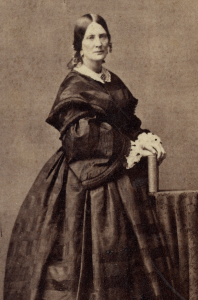
The Dinner hour since I have been here, has been two oclock, to suit Mr Lincoln’s convenience as it is of regular courses, and lasts about an hour and [a] half—The set of dishes, are of course different in size, from those of the other meals, but belong to the same pattern—Supper generally at six o’clock—before supper we ride with Mrs. Lincoln, & Mrs. [Elizabeth Todd] Grimsley—a cousin—in the handsome carriage of the White House, and are the observed of all observers—
In the evening the ladies rec[eive] their company, which time is devoted to that purpose entirely—all callers of the day are put off until that time. Mrs. Lincoln never visits any one, but everyone can visit her.
The blue room is her reception room—the red room—is considered the family room, but I see that she takes her company to that room most frequently.
The chambers are so very pleasant that we all spend most of the day there—except the library, which belongs to Bob & myself exclusively—except when the ladies brave the smoke to play us a joke, or lay plans for some excursion of pleasure or other.
The furniture throughout the whole House is handsome—Our chamber is elegant—it is Mr. Buchanan’s old room, now the guests’ chamber, it has been entirely refurnished—furniture is covered with purple flowered silk, bordered with gold heavy—the cornice of the windows are very heavy gilding, with the sheath of the US—in the centre of each window—Over the head of the bed is some ornament of gilding heavy—from which curtains drape over the bed—the bed itself is exceedingly handsome the sides are stuffed with cotton, covered with the same silk covering upon the chairs and sofas—
Mrs. Lincoln is quite anxious that I should go with her to Long Branch [New Jersey, a fashionable summer resort], and I have about half promised that I would, for a few days.
It will be attended with but little expense. The entire party goes upon invitation of proprietor of Hotel.
affect
Dick
Richard Meconkey to Jennie Johnson
Executive Mansion, Washington, D.C., July 28, 1861
Jennie: . . .
I had been to Philada. the day that I left, almost all-day, returned home at six o’clock in eve, immediately packed up and came off at seven o’clock to Washington. Where I have been having the most delightfullest time imaginable ever since. The entire family are just as kind as they can be, and every thing here that one could desire to furnish a good time, and Bob & myself I don’t hardly think, are ones to refuse sport.
Mrs. Lincoln is a “perfect Brick”—generally up to some joke upon us, and you may bet that we reciprocate a little.
We all hands (The President only occasionally) go to ride every afternoon, in the Presidential equipage—and of course excite the attention of all passers by (which is very annoying to me, a modest youth) and salutes from the Soldiers throughout the city. Yesterday afternoon, the full Marine Band, gave their customary concert to the inmates of the White House in the yard fronting the Potomac—the Grounds were crowded by Ladies & Gentlemen of the City, and the entire affair quite brilliant. Next Tuesday evening, Mrs. L. holds another public reception, and means it to be the grandest of the season. The following Monday or Tuesday she leaves for “Long Branch” for the Summer—She has invited me most kindly to go with her and I rather think I will for a few days, but can’t tell so long ahead. Bob & I will come to West Chester before we go anyhow, and then decide whether it will be expedient or not. I shall come home some time this week—about Thursday if I can get off. . . .
Dick
Richard Meconkey to David Meconkey
Washington, D.C., July 31, 1861
Dear Father, . . .
The public reception was held by the President last evening—it was not as brilliant as they had expected, but nevertheless very well attended, to me, it appeared crowded.
The Soldiers were the main body of the assemblage, last evening—several foreign ministers and very few Ladies (young) somewhat to the disappointment and chagrin, of Bob & myself.
The thing, however, was a novelty to me, and afforded enough that was new, to occupy my attention. The order of exercises, were briefly these—The President attended by an usher & his Private Sec. stood in the reception room, between the Red & Blue rooms, and shook hands with the entire crowd, as they defiled past him. The Mrs. President stood some distance to the right of the “Tycoon” also attended by an usher, receiving, and being complimented by those of the crowd who wished to speak to her. Generally the big stock—Ambassadors, [William Howard] Russell & other reporters, & corpulent gentlemen—. Lord Lyons [British minister to the United States] was pointed out to me. Gen. [Winfield] Scott was not present.
Mrs. Lincoln seems quite unwilling that we should leave until the beginning of next week. But we are rather inclined towards withdrawing from the heat of the latitude, some time during the course of the present week. Bob will stay with me, until next Saturday a week, then probably join his Mother at Long Branch.
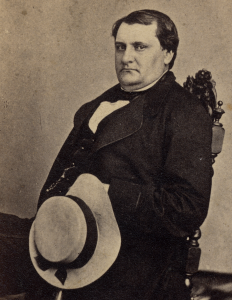
Prince Napoléon Joseph Charles Paul Bonaparte of France, who visited Lincoln at the White House in August 1861, about the time this photograph was taken (LFA-0191)
The Royalty of France [Prince Napoleon, Princess Clothilde, Duchess D’Abrantes, and suite of guests], who are now in New York—are expected here next Monday or Tuesday. Mrs. Lincoln gives them a grand Dinner, and just told me that I must stay and attend it—then all hands go north together—She & Mrs. Grimsley to Long Branch[,] Bob & myself to West Chester.
It will be some thing, to dine with a Princess & Duchess and I will consider her proposal. . . . Tell Mother that Washington, I think, is safe. . . .
Affectionately
Your Son.
Richard Meconkey to Sarah Meconkey
Washington, D.C., August 2, 1861
Dear Mother,
Your letter[,] I believe I informed you in my last to Father, came to hand early part of the week. My visit has been more protracted, than I had proposed it when I left home—owing to the kind treatment and comfortable quarters, that I have experienced—and the many inducements to keep one, who has a vacation before him, to be spent in the literal sense of the word. I had nothing in particular, to require me to be at home, and concluded that, the urgent invitation of Mrs. Lincoln, to be present at the dinner to Prince Napoleon & the Cabinet, on Saturday (tomorrow) ought not to be disregarded. The Ladies of the Suit[e], will not be present—at which we are all considerably disappointed. It will be a Gentlemen’s Dinner, exclusively, with exception of the Ladies of the House.
The Prince with two or three of his Suit[e]—Gen. Scott, Gen. McClellan and about half of the Cabinet. The whole number of persons at table, to be, twenty-nine.
The dinner hour, is seven o’clock. The whole operation will probably last two to three hours, which appears quite appalling to contemplate.
I will tell you all about it when it is through with.
Bob & I expect to come on next Monday—we can leave here at 2½ o’clock, and make home the same evening, in last train arriving about eleven I believe. I rode with the President last evening to the Navy Yard, to witness the trial of a new gun—he is very agreeable in his family—has an infinite stock of good humor and mirth in him, which he lets off by anecdotes & jokes. I would like to say in regard to his drinking propensities—that at the table, he rarely, now and then, takes a glass of Claret—and that his glass of Champagne invariably stands unemptied, when even the Servant fills it—which he does only when some Stranger is at the table, merely out of courtesy. He says that he has no taste for liquors. . . .
Affectionately
Dick
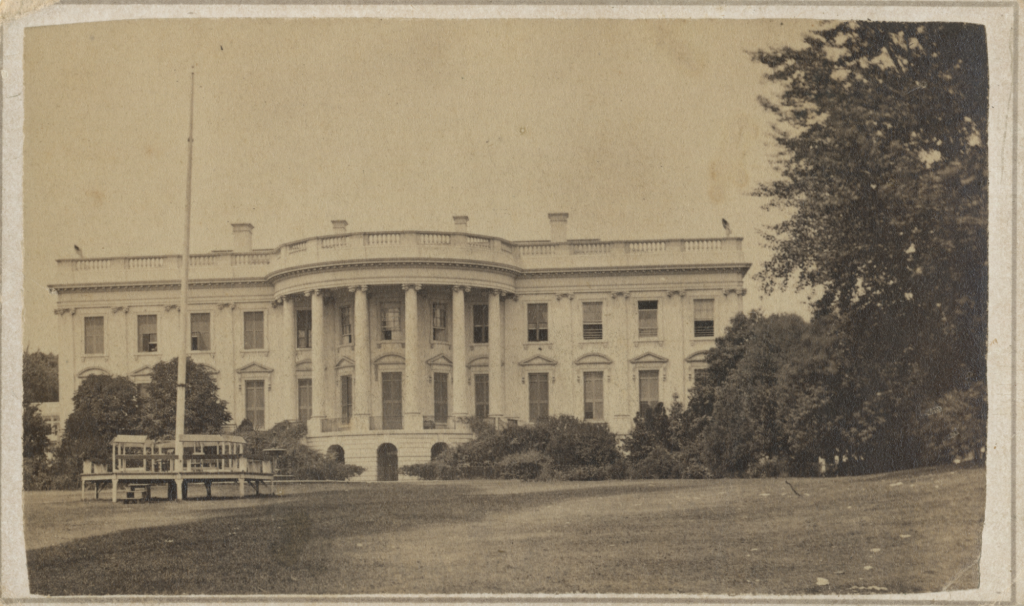
The White House (LFA-0384)
Richard Meconkey to Jennie Johnson
New York City, August 15, 1861
Jennie:
You perceive that we are still at New York—We go to Long Branch this PM. at 4 o’clock.
Mrs. Lincoln & suite did not arrive until last evening[.] Letters came to West Chester stating that she would not leave Washington until yesterday (Wednesday) morning—but they came an hour too late to reach us—The weather has been disagreeable here, and for several other reasons, we are sorry that we didn’t receive the letters, as in that case we should have remained in West Chester a few days longer, and should have accomplished that trip to Pines, and other trips, too aggravating to mention now.
Well I shall be home on Monday evening next—positively—My sojourn at Long Branch will necessarily be short—but I rather expect that it would get played out if I stayed over two or three days. So you can make the arrangements in regard to “Radnor,” knowing that I will be at your service after Monday. By George—it makes me quake, when I reflect how soon my presence will be demanded at Cambridge. Only one week from next Tuesday and I pack my duds and travel. This entire vacation of nearly five weeks, thus far, appears like about ten days altogether. . . .
Most truly,
your friend
Dick.
Richard Meconkey to Sarah Meconkey
Niagara, August 28, 1861
Dear Mother,
I have snatched a few minutes, while the rest of the party are preparing for tea, to write you briefly of our trip, thus far completed.
I met Bob, at the Continental, as expected, and came to New York in the night without accident or interruption.
Mrs. Lincoln & Ladies have been here since Friday, but after the manner of woman’s extreme impunctuality, was not prepared to start for the Falls, until the evening of yesterday, thereby compelling us to travel all night. The plan however was a better one, I think, since we had sufficient time before dark, to see the beauty and magnificence of the banks of the Hudson. And at Albany after dark, took possession of an elegantly arranged sleeping car, chartered for us by telegraph. In which we enjoyed a good night’s rest, and escaped the otherwise exceeding monotony of the long ride from Albany to Rochester. We had a special car from New York up the Hudson, which Gov. Seward had retained for himself being on his road home, from Washington, to spend a day with his family [in Auburn, New York], After an absence since December last.
The news of Mrs. Lincoln’s and the Governor’s presence on the train had been heralded over the route by telegraph—and of course every station that the cars stopped at, was crowded with people, cheering for the President, his Lady, his Cabinet, the Union, the Suite, and everything-in-general.
Mr. Seward left us at or near Rochester—
There we breakfasted, then took cars for Niagara [Falls], where we arrived about half past nine this morning. We all felt very dirty after our ride, of sixteen hours, and made straight for the bath-rooms, as soon as our baggage had been delivered. After a good souse and Clean Linen, Bob and I felt refreshed enough to take a stroll about the Falls, on the American side, before an early dinner. After we had dined, all hands took carriages, and drove to the suspension bridge, over into Canada, up to the Clifton House opposite the Falls, and there disembarked to enjoy the extensive view from the upper balcony. While I took the opportunity, of donning water proofs, and making an excursion beneath the Cataract.
I walked some hundred feet along the rocks, between the water and the precipice, with the spray dashing into my face and the water pouring over threateningly within a few feet of me. From thence we drove around through “Lundy’s Lane” [War of 1812 battle site] back to the bridge and to our Hotel again. Bob and I leave for Boston, tonight at 10½ o’clock taking the sleeping car and will arrive at 4½ tomorrow. Mrs. Lincoln inquired after you and Father. Regrets very much that we leave so soon. I will write again on Sunday.
In haste, affectionately
Dick
Richard Meconkey to Sarah Meconkey
Executive Mansion, Washington, D.C.,
February 10, 1862
Dear Mother,
We have just returned from a fresh morning’s ride upon the Avenue, in the President’s carriage. It is quite amusing to notice people turn around, and stare and look, and endeavor to indelibly stamp upon their memories the features of the occupants of the White House, as they grandly roll by in the carriage of state. . . . Last week was without doubt the gayest week of the season—there appeared to be two or even three hops on hand, every evening—There were four different invitations sent us one evening.
On Saturday, Major [William Worthington] Russell made up an excursion of Senators & families—and big-guns generally—to leave the Navy Yard at 12 M [noon], upon a nice little pleasure steamer—for Mount Vernon—and below Indian Head, within range of the guns of the first rebel batteries. We could distinctly see their tents—and with a glass could easily distinguish heavy guns mounted upon bristling earth works.
There were a number of good-sized vessels laying off the point, awaiting the cover of night, to slip by their ineffectually secured cannon.
The party numbered about thirty couples—had the Marine Band aboard, the large Ladies Cabin below deck, rigged as a ball-room, and everything charming throughout the entire day.
It was a party, that had it fallen into the hands of the enemy, it would have enabled them to dictate their own terms in regard to treatment, and exchange, of prisoners of war.
We hold superintendence of a large spy-glass belonging to the house—and amuse ourselves at odd hours by studying the Virginia side of the river of which there is an excellent view from the top of the Executive Mansion. Those noble hills lopped of their rich timber growth, present a realizing sense of the barren and desolate waste caused by the ravages of war.
I hope you saw the Herald’s account of the [February 5] Ball at the President’s—I tried to secure a copy in order to send it to you but couldn’t.
Tell Father that I would be very much obliged if he could enclose me five dollars in his next letter. I have had to lay out nearly that amount since I came in party dress—white cravat, white gloves etc etc, and will run short with the amount that he gave me at starting.
I shall try and inform you of every thing of interest that transpires in the course of the week.
Most affectionately
Your Son,
Dick
Robert Lincoln to Richard Meconkey
Executive Mansion, Washington, D.C.,
July 25, 1862
My Dear Dick,
I have been expecting to hear from you as I did not know when you would get home. I have been here just a week and very busy doing nothing. It is the dullest place you ever saw, with one exception: Exeter on a rainy day.
We are living in a very pleasant place—the “Soldiers Home” but it is too quiet. I have not been out there since yesterday morning.
There is a large number of Generals here at present—among them Pope, Halleck, Burnside & Mitchell.
There are lots of men here after Collectorships, & whenever I go down to Willard’s I am the center of an admiring crowd. It has got played out. . . .
My regards to your family—
Yours
R.T.L.
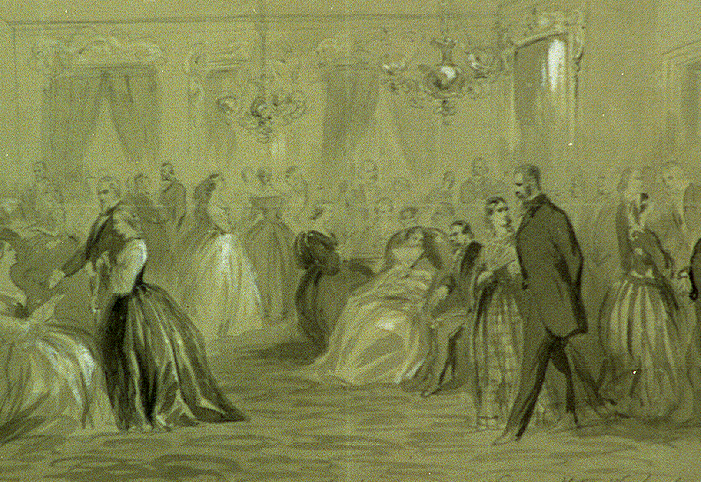
The Ladies’ Parlor at Willard’s Hotel, ca. March 1861 (Prints and Photographs Division, Library of Congress)
A Note on Richard Meconkey
Two additional notes from Robert Lincoln, dated August 1862, asking his friend Dick to vacation with him at Long Branch, New Jersey, are the last two letters in the Meconkey family papers. Whether the two young men drifted apart and so stopped corresponding or any additional letters simply no longer exist is unclear. The two families appeared to be on good terms throughout the war, however. On October 9, 1862, President Lincoln requested Elbridge Meconkey (Richard’s older brother) be appointed a quartermaster if a position was available; and in early May 1864 Sarah Meconkey inquired after the president’s “health and personal welfare,” to which he replied on May 9, “I have been very anxious for some days in regard to our armies in the field, but am considerably cheered, just now, by favorable news from them.”
Meconkey dropped out of Harvard in March 1864, shortly before completing his senior year, due to “ill health.” Apparently, he suffered from some sort of mental or emotional breakdown and was placed in an asylum during the summer of 1864, according to the Harvard Class of 1864 Secretary’s Reports in the following years. His health “slowly but gradually” improved, and he turned to farming. By the end of 1872, “a change for the worse took place in his condition,” the 1874 report states. “He begged to be allowed his liberty a little longer, promising not to injure himself or others. On the afternoon of February 5, 1873, however, he managed to escape from his attendant, and was soon found alone in the reservoir, into which he had thrown himself. All efforts to resuscitate him proved fruitless.” He was 31.
Jason Emerson is the author or editor of seven books about Abraham Lincoln and his family, including Giant in the Shadows: The Life of Robert T. Lincoln (2012), The Madness of Mary Lincoln (2007), and Lincoln the Inventor (2009). He is currently compiling a new edition of Mary Lincoln’s letters and asks anyone who owns or knows of unpublished Mary Lincoln letters to contact him at [email protected].