
“Fixed Upon My Imagination”: Abraham Lincoln and Washington’s Crossing
“Fixed Upon My Imagination”: Abraham Lincoln and Washington’s Crossing
by Jonathan W. White
As a young boy in Indiana, Abraham Lincoln read at least two biographies of George Washington. When he was about fourteen years old, he borrowed a copy of David Ramsay’s The Life of George Washington (1807) from his neighbor Josiah Crawford. When the book got wet from rain that seeped into the Lincoln cabin, Crawford required Abe to cut corn for three days to pay for it.
The reading Lincoln did as a child stuck with him for the rest of his life. When he addressed the New Jersey state senate on February 21, 1861, he recollected “away back in my childhood, the earliest days of my being able to read, I got hold of a small book . . . ‘Weem’s Life of Washington.’” Lincoln told the state senators: “I remember all the accounts there given of the battle fields and struggles for the liberties of the country, and none fixed themselves upon my imagination so deeply” as the Patriots’ struggle at Trenton at Christmastime in 1776. “The crossing of the river; the contest with the Hessians; the great hardships endured at that time, all fixed themselves on my memory more than any single revolutionary event; and you all know, for you have all been boys, how these early impressions last longer than any others.” Lincoln recollected “thinking then, boy even though I was, that there must have been something more than common that those men struggled for.” Now, as president-elect, he was “exceedingly anxious that that thing which they struggled for”—national independence, the “Union, the Constitution, and the liberties of the people”—shall be saved “in accordance with the original idea for which that struggle was made.”
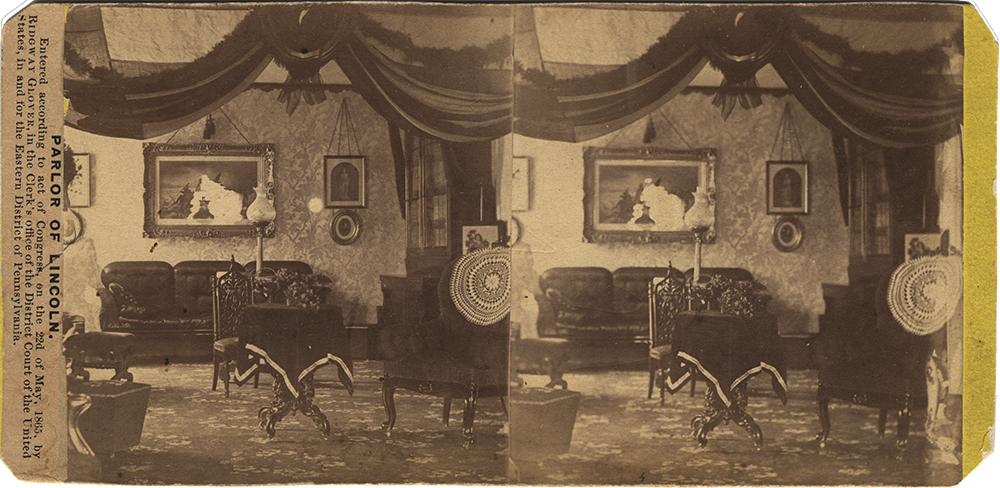
Emanuel Leutze’s 1851 painting “Washington Crossing the Delaware” also helped fix this pivotal moment in Americans’ memories and imaginations. A copy of the epic artwork was put on display in April 1864 at the Great Metropolitan Fair in New York City, where thousands of visitors gazed up at the iconic scene. Prints of the painting could also be purchased and displayed in the home. This stereoscopic view, taken in Springfield in May 1865, reveals a print of Leutze’s painting on the wall of Lincoln’s parlor. The print had not appeared in an engraving of Lincoln’s parlor published in Frank Leslie’s Illustrated Newspaper in March 1861, indicating that it was likely hung by the Tilton family, who rented Lincoln’s home during the Civil War. Nevertheless, Lincoln would likely have been pleased to know that “Washington Crossing the Delaware” graced his parlor wall as he struggled to preserve what Washington had struggled to create.