
Book Review – Grant, Lincoln, and the Freedmen: Reminiscences of the Civil War
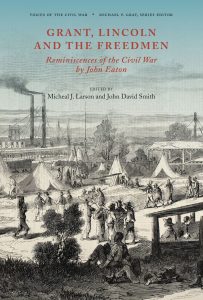 Book Review – Grant, Lincoln, and the Freedmen: Reminiscences of the Civil War by John Eaton
edited by Michael J. Larson and John David Smith
Review by Andrew F. Lang
Amid the welter of post-Civil War reminiscences, John Eaton’s Grant, Lincoln and the Freedmen is a monumental achievement. The memoir abjures trivial partisanship and romantic hagiography, an uncommon feat within the vast contemporaneous literature. Eaton nonetheless worshipped the two men who adorn his title. He thus aimed “to give a faithful picture of the great President and the great General who guided us through the most tragic period of our National life.”
Such sentiments might parrot boilerplate Civil War-era nostalgia, though Eaton harbored a resolute objective. Published posthumously in 1907, the memoir appeared when the promise of emancipation and biracial civil rights endured great peril. The ripe fruits of the War for the Union now suffered relentless attacks from Jim Crow. Meanwhile, a nauseating cultural amnesia valorized the Confederate Lost Cause. Eaton implored his readers that a free republic depended on “devotion to our heroes and reverence for the ideals to which they pledged themselves.”
Eaton’s appeal rings hollow in our modern iconoclastic age. The fixation on “disrupting” or “reimagining” American history reduces the nation’s virtuous leaders to their otherwise ignoble vices. The effort yields a nihilistic relativism that releases the “enlightened” present from any obligation to the past. Eaton anticipated and deplored this trend. When he gazed on “the character and standards” of Abraham Lincoln and Ulysses S. Grant, he found cures to civic fracture: respect, gratitude, and devotion to the objective good of history.
Eaton portrays decent men who pursued the right amid the revolutionary chaos of civil war. Lincoln and Grant attempted to conquer the arresting impasse of human bondage within a natural rights republic. Theirs was an honorable goal, and they triumphed. “The Negro’s status,” Eaton concluded, “changed from that of slave to freeman.” And yet, Eaton warned that complacency in victory bred regression. The fundamental charge of the nation’s new birth of freedom depended not on dispensing with but acquiescing to history. Lincoln, Grant, and especially those millions freed from chattel slavery understood this injunction. Echoing the two men he knew and most admired, Eaton reminds us that a more perfect Union necessitates generational reaffirmation to the proposition that freedom is not a stillborn gift, isolated in a distant historical epoch.
For more than a century, historians have elevated Grant, Lincoln and the Freedmen among the most consequential Civil War memoirs. But it appears now, for the first time, professionally edited and annotated by the superb talents of Micheal J. Larson and John David Smith. A masterwork of documentary editing and historical literacy, Larson and Smith’s volume includes an extensive, first-rate introduction, bolstered by deep, discursive notes that texture Eaton’s narrative. Despite critics who gently dismiss Eaton as a mid-nineteenth-century paternalist, Larson and Smith present him as “an enlightened yet conservative” humanitarian. Eaton’s work in the complex process of wartime emancipation enlivened his moral hostility to “slavery’s barbarities.” He did not consider emancipation a means to an end. It was an end—if not a beginning—unto itself, a moment that compelled the nation to confront its destructive dogmas. And at the drama’s nexus he met the great statesman and soldier.
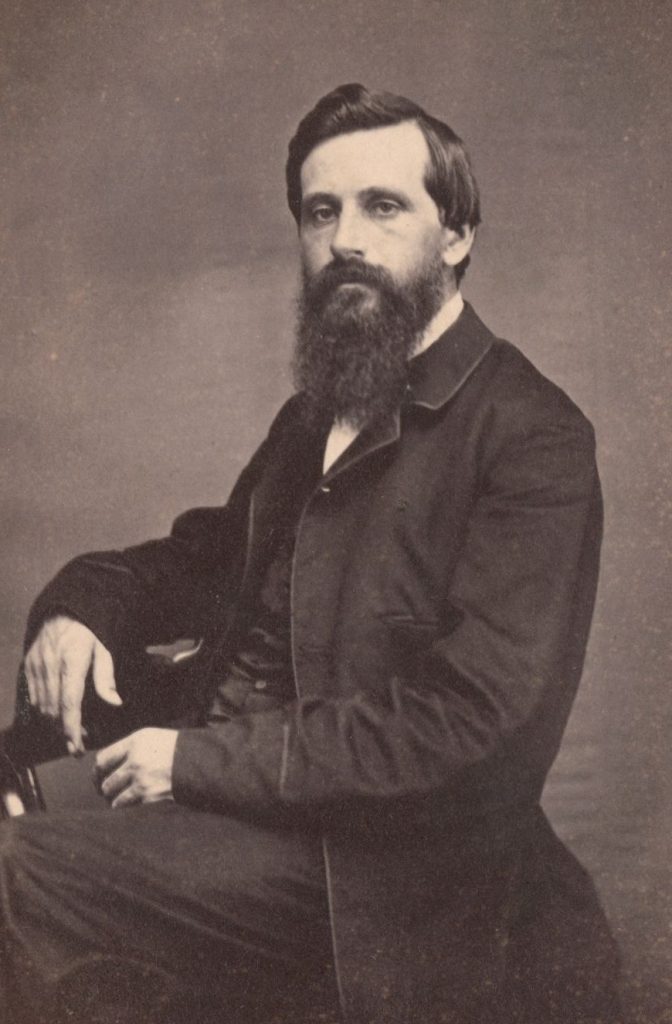
Born in 1829 in Sutton, New Hampshire, Eaton graduated from Dartmouth College and later trained as a minister at Andover Theological Seminary. Ordained in 1861, he enlisted as a chaplain in the 27th Ohio Volunteer Infantry, which experienced early service in Missouri, Tennessee, and Mississippi. In November 1862, Maj. Gen. Grant appointed Eaton Superintendent of Freedmen in the Department of the Tennessee, tasking him with managing the influx of formerly enslaved people seeking refuge within Union lines. Eaton organized camps, secured work and education for thousands of refugees, and established the foundation for the creation of the Freedmen’s Bureau, where he later served as an assistant commissioner. In early 1864, Eaton held the rank of colonel in the 63rd United States Colored Troops. After the war, as a fierce advocate of public education, Eaton became U.S. Commissioner of Education, a post he held from 1870 to 1886.
Eaton’s remarkable wartime career brought him into intimate professional collaboration with Grant and Lincoln. He conversed extensively with the general and even on myriad occasions held private meetings with the president at the White House. His reputation as a forthright, philanthropic humanitarian convinced the Union’s foremost leaders of his ability to manage the unprecedented refugee crisis spawned by the war’s overwhelming human displacement. As United States armies penetrated the Confederate interior, tens and later hundreds of thousands of enslaved people sought sanctuary behind the lines. What was their status? What was the army’s, much less the government’s, obligation to wartime refugees? What did freedom mean?
Answers to these unprecedented questions demanded moral calculus. Wartime emancipation policies emerged almost as soon as the conflict opened, beginning with the Confiscation Acts of 1861 and 1862. But humanitarian concerns were left largely to those on the front lines. When Grant selected Eaton as Superintendent of Freedmen, the former chaplain faced a near-impossible situation. “The whole question of methods dealing with the Negro had scarcely as yet been faced by the National Government,” he wrote. In real time, Eaton watched the process of self-emancipation crack the once impenetrable shell of American slavery. And here was an obscure army chaplain now tasked with implementing revolutionary policies to address revolutionary circumstances.
Eaton embodied the Whig-Republican ideal that considered all humans the rightful owners of their bodies, consciences, and labor. “The complications arising out of the conditions of slavery,” he thus observed, “must be met and solved.” His work in the Mississippi Valley aimed to transform a stolid feudal aristocracy into an embryonic free-labor region. “To make the Negro a consciously self-supporting unit in the society in which he found himself, and start him on the way to self-respecting citizenship,” he explained, “was the beginning and the end of all our efforts.” Eaton did not dismiss the formerly enslaved as passive bystanders who were incapable of freedom. They were victims of a cruel system that stole individual dignity and the natural right to personal autonomy. Eaton genuinely believed in “the capacity of the Negro to take care of himself and exercise under honest and competent direction the functions of self-government.” And in the dim dawn of liberation, freedpeople exhibited the traits of a thriving republican polity: the quests for personal improvement, economic mobility, and education.
Eaton’s jurisdiction in the Department of the Tennessee oversaw nearly 114,000 former bondspeople. Approximately one-third received wages from the army as skilled mechanics, cooks, and laundresses. Meanwhile, more than half produced as fully self-sufficient laborers on deserted plantations. A sizeable number also pursued education. To be sure, freedom in the wake of slavery was hardly idyllic. While rampant diseases debilitated refugee camps, freedpeople also withstood violent plantation raids from Confederate guerrillas. Despite disproportionate pay, the corruptions of the plantation leasing system, and the necessities of laboring for the Union war effort, Eaton highlighted the rapid changes sweeping the Mississippi Valley. “The systems of education and industry devised for the Negro were of the utmost value here, for nothing so completely demonstrated the ideal of free labor and of ultimately equal rights and opportunities for all.”
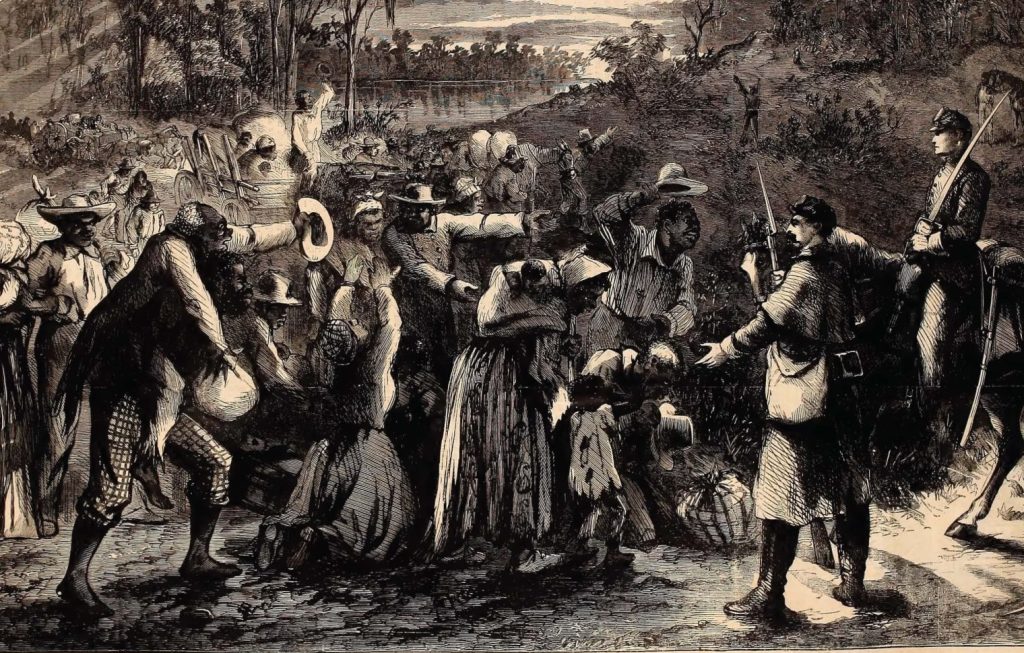
Eaton emphasized the fundamental transformation in the relationship between the nation and Black Americans. No longer could people of color be so callously dismissed as mere merchandise, as static creatures powerless to improve and live with dignified independence. That “the black man suffered from the degradation of his lot as slave,” so he also “yearned for freedom,” and thus “did he personally justify the struggle which freed him; and in just so far is he entitled to his manhood.” The promise of freedom would take decades to manifest. But its roots were planted in the very soil once home to the world’s largest and richest slaveholding regime, now succumbing to the terrible swift sword.
Larson and Smith contest the simplistic criticism of Eaton as a white paternalist. Though a racial egalitarian, Eaton also believed that the formerly enslaved needed guidance, direction, and education out of the corrupting effects of slavery. But paternalism exists in the eye of the beholder. Eaton maintained genuine faith in Black humanity and the ability of all people to advance into self-sufficient autonomous individuals. Paternalism implies—and is often echoed today in various professional quarters—self-insufficiency and incapability. Eaton scoffed at such presumptuousness. He found in the Mississippi Valley “various forms of suffering, disease, and death” caused by the evils of slavery and the upheaval of civil war. “To evoke from this chaos conditions in which the whole mass might promptly live and labor with some assurance of justice and security, demanded, certainly, a definite system regulating industrial relations, and a vehicle of organization by which that system could be enforced.”
If that tremendous scenario “involved a type of paternalism,” Eaton admitted, then so be it. But his was hardly the infantilizing paternalism of slaveholders and some abolitionists. Eaton’s, rather, exhibited the pragmatic calculus of wartime contingency cut from moral duty. And this is what caught Grant’s attention. In June 1863, Grant wrote to Lincoln praising Eaton’s striking efforts as superintendent. “Mr. Eaton’s labors in his undertaking have been unremitting and skilful,” the general wrote. “He has been of very great service to the blacks in having them provided for when otherwise they would have been neglected.”
So impressed was he by a detailed thirty-four-page report penned by Eaton that Grant encouraged the chaplain to deliver the document personally to the president. Upon meeting Lincoln for the first time, Eaton observed the man’s “kindness of heart.” But he also saw “the spectacle of the President of the United States, conducting the affairs of the Nation in the midst of civil war, and genuinely affected by the discomfort” experienced by the freedpeople in their trial of liberation. The president’s concern derived from his egalitarian nature in which “there was not the slightest affectation, nor assumption of superiority.”
During their myriad wartime meetings, Eaton always noted Lincoln’s aching empathy. He documented Lincoln’s great pain for those who most suffered in the maelstrom of modern war. Eaton also saw in Lincoln a version of himself. The president was hardly a utopian idealist. And like Eaton’s hero, Grant, the president was a principled pragmatist whose moral core directed his actions. All three men retained an unbending faith in American institutions, in the nation’s virtues, in the human capacity to self-govern and better one’s lot in life. Such traits informed their commitment to emancipation. The attributes also revealed Lincoln’s enduring curiosity about Grant. The president always asked Eaton about that quiet general, how he intended to fight, whether he possessed the mettle to continue the war unabated.
It was less that Lincoln doubted Grant’s ability or commitment. It was, rather, that so few grasped what the war was truly about. The conflict tested not only the propositions of democracy and Union. The war also demanded of all Americans to determine the kind of Union that would emerge in the wake of secession and emancipation. On this matter, Eaton conceded, “these two men saw eye to eye, and recognized the essential elements in the issues that were presented.” Lincoln and Grant came to believe that such elements were not up for debate. The war compelled national acquiescence to the self-evident truth of natural human equality, the dignity of the individual, the near sacredness of Union, and the flustering reality that divine Providence had punished a guilty republic.
John Eaton leaves us with a portrait of two men who were hardly perfect. But in Lincoln’s and Grant’s imperfections we also see the transcendent traits of the American statesman: a modest resoluteness, a scorn for impulsiveness, a firmness in the right, a recognition that moral deference is not subject to the whims of passion. For Eaton, both Grant and Lincoln embodied “the simple and fundamental elements of character. Both were essentially sane in morals and in intellect.” Perhaps most striking, neither Grant nor Lincoln were remarkable men. “Both were normal men first and great men afterwards.” Benevolent, humble, and altruistic, they were the kind of common citizens on whom a free republic depends. In our own age of political demagoguery, may we realign our national disposition away from the lusts of the present and back toward those enduring virtues of the past.
Andrew F. Lang is associate professor of history at Mississippi State University. He is the author most recently of A Contest of Civilizations: Exposing the Crisis of American Exceptionalism in the Civil War Era (2022), which was a finalist for the Gilder Lehrman Lincoln Prize. A recipient of the Society of Civil War Historians’ Tom Watson Brown Book Award, he is now writing an intellectual and cultural biography of Lincoln’s nationalism.